
Quality, compliance, and operations teams in pharma and medical devices live with constant regulatory pressure. Tracking what FDA investigators are actually citing gets harder when there's no single, comprehensive government database of Form 483s to work from. Every 483 flags potential violations and expects fast corrective action, so knowing what's in the field matters.
The FDA issues thousands of Form 483s each fiscal year across regulated areas. The most common observations cluster around inadequate procedures, poor documentation, and quality system failures, which is why staying on top of recurring inspection trends is core to a credible compliance program.
Whether you're addressing a recent inspection or building a forward-looking compliance strategy, this resource offers practical guidance to help your team reduce risk, improve readiness, and stay in regulatory alignment.
What Is the FDA Form 483 Database?
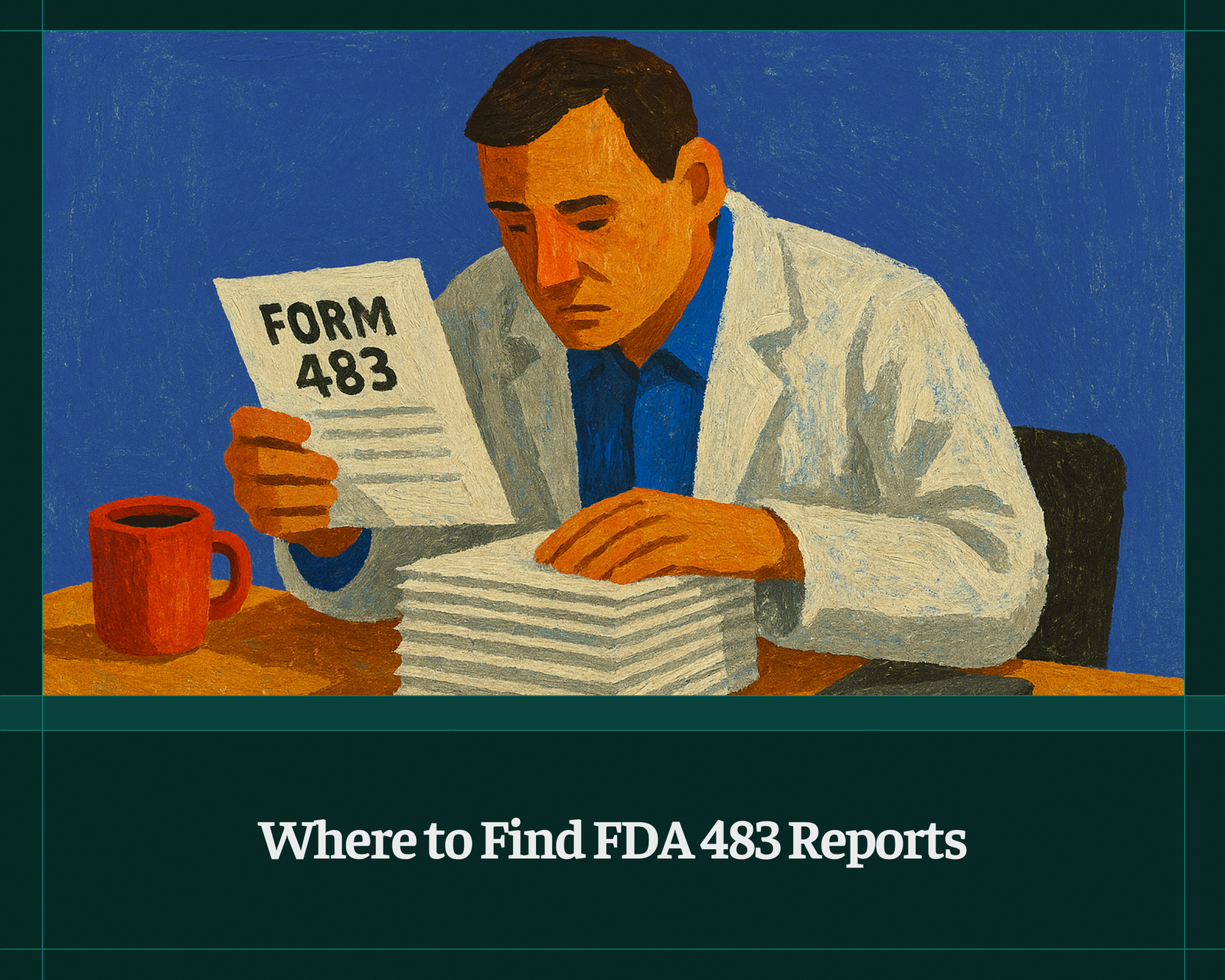
FDA Form 483 is an official document issued by the U.S. Food and Drug Administration (FDA) to a company at the conclusion of an inspection. It lists observations made by FDA investigators regarding potential violations of the Federal Food, Drug, and Cosmetic (FD&C) Act and other applicable regulations. These observations signal areas where a facility may need to take corrective action to ensure compliance with FDA standards.
The FDA Form 483 database is a repository of these inspectional observations, documenting potential regulatory violations identified by FDA investigators during inspections. These reports, formally known as FDA Form 483s, are issued to companies when FDA investigators identify conditions during an inspection that may violate the Federal Food, Drug, and Cosmetic (FD&C) Act or other applicable regulations.
Each record typically contains:
- Company or Facility Name: The legal name of the organization that was inspected.
- Location of the Inspection: The city, state, and country where the inspection took place.
- Date of Inspection: The specific dates during which the inspection occurred.
- Date the Form 483 Was Issued: The date the official Form 483 was handed to the company.
- Text of the Observations: A narrative description of the conditions, procedures, or practices that the FDA investigator found concerning. These observations may include direct quotes from the Form 483 and detail specific deficiencies.
- Type of Facility: The nature of the facility inspected, such as a drug manufacturer, medical device company, biologics producer, food processor, or cosmetics maker.
The Form 483 itself is a formal notice that highlights potential regulatory violations observed during the inspection. These observations might include:
- Inadequate or missing quality control procedures
- Poor documentation practices
- Unsanitary production environments
- Equipment or process validation issues
- Non-compliance with current Good Manufacturing Practices (cGMP)
While the issuance of a Form 483 does not necessarily mean the FDA will take further action, it serves as a critical warning that corrective measures are expected. Reviewing the database can help companies anticipate regulatory expectations and identify patterns in enforcement activity across the industry.
Where to Access the FDA Form 483 Database?
There is no single, comprehensive, fully searchable FDA-maintained database dedicated solely to Form 483 reports. However, there are multiple ways to access these inspection documents, each with its own advantages depending on your needs, budget, and familiarity with regulatory systems.
1. FDA's FOIA Electronic Reading Room
The FDA Freedom of Information Act (FOIA) Electronic Reading Room is an official government resource that provides public access to records, including selected Form 483 reports.
How to Use It:
- Visit the FDA FOIA Reading Room.
- Use the search tool to locate inspection-related documents.
- You can filter by date, product type, or facility name to locate relevant FDA Form 483s.
Pros:
- Free and directly from the FDA.
- Ideal for users with experience navigating regulatory portals.
Cons:
- The interface can be unintuitive.
- Search functions are limited and not always user-friendly.
- Not all Form 483s are published here; selection is based on public interest or prior FOIA requests.
2. Requesting FDA 483 Reports via FOIA
If a specific Form 483 is not available in the Electronic Reading Room, you can submit a FOIA request directly to the FDA.
How to File a FOIA Request:
- Visit the FDA's FOIA Request Page.
- Submit a detailed request specifying the company, date range, and facility type.
Pros:
- Guarantees access to a specific report if it exists.
- Useful for targeted requests or historical data.
Cons:
- Response times vary (can take weeks or months).
- Some documents may be heavily redacted.
*Also read: [Effective FDA Form 483 Response Strategies*](/blog/effective-fda-form-483-response-strategies)
3. FDZilla: A Third-Party Form 483 Database
FDZilla is a well-known third-party database that compiles FDA Form 483 reports, offering a significantly more user-friendly experience than government systems.
Features:
- Searchable by company name, inspection date, observation type, and more.
- Offers trend analysis and benchmarking tools.
- Allows for advanced filtering and report downloading.
Pros:
- Fast, intuitive search and navigation.
- Explicitly designed for regulatory professionals and compliance teams.
Cons:
- Access usually requires a paid subscription or fee.
- Limited to reports they've obtained via FOIA or public access.
Examining real-world FDA 483 cases brings the data to life and helps illustrate the most common compliance pitfalls.
Real World Examples
1. Inadequate Area Separation in Aseptic Processing
Brassica Pharma Pvt Ltd was inspected by FDA investigators Anastasia M. Shields and Justin A. Boyd on January 19, 2024. During the inspection, the company was cited for inadequate area separation in its aseptic processing operations, which posed a serious cross-contamination risk.
Issue: The FDA cited the facility for inadequate segregation between sterile and non-sterile zones, posing a significant cross-contamination risk in aseptic processing environments.
Root Cause: Noncompliance with procedural protocols and insufficient documentation practices.
Corrective Actions: The company revised and reinforced standard operating procedures (SOPs) to clearly define area separation requirements and documentation standards.
Preventive Measures: Ongoing staff training on contamination control and aseptic procedures was implemented to reduce recurrence.
2. Unqualified or Poorly Maintained Manufacturing Equipment
Orly International, Inc. underwent an FDA inspection on December 20, 2022, conducted by Crystal Monroy and Carolina D. Vasquez. The inspection revealed that the company was using manufacturing equipment that had not been adequately qualified or maintained, raising compliance concerns.
Issue: Manufacturing equipment was found to be inadequately qualified and not properly maintained, raising concerns over product quality and compliance.
Root Cause: The company failed to incorporate equipment qualification into the batch production lifecycle.
Corrective Actions: All production equipment underwent qualification before future batch use to ensure it met operational and regulatory standards.
Preventive Measures: Routine equipment checks were integrated into the batch record review process to ensure ongoing compliance.
 Atlas
AtlasSee what the FDA knows about your next investigator.
30 minutes with the founder. No pitch deck.
How Atlas Delivers FDA Inspection Intelligence
Atlas gives pharma and medical device quality teams the most comprehensive FDA inspection and enforcement database available, with data typically arriving within a business week of an inspection through proprietary market intelligence.
Atlas covers:
- 30,000+ Form 483s and EIRs
- 11,828 warning letters
- Warning letter context
- CFR citations indexed across every observation
- 6,000+ investigator reports with focus areas and citation patterns
Key benefits:
- Complete data guarantee: 700,000+ FDA inspections since 2010 and 100,000+ searchable observations. If Atlas doesn't have it, nobody does.
- Sub-1-second AI-enabled search: Query by company, site, investigator, CFR code, or keyword and get answers in under a second.
- AI copilot: Ask natural-language questions about any investigator, observation, or CFR code, in any language, and get a structured, actionable answer.
- Custom analytics and alerts: Rapidly built dashboards for your exact use case, at no extra cost. Email and WhatsApp alerts on suppliers, competitors, or specific investigators.
- Direct engineering support: Built by ex-Google engineers. No account managers, no tiers.
Ideal for:
- Quality, compliance, and regulatory affairs teams
- Pharma and medical device manufacturers seeking continuous improvement
- Teams reducing audit risk and monitoring suppliers or external manufacturers
Atlas turns quality teams from FDA data gatherers into data users. Instead of hunting documents, teams get actionable insights in the format they need.
Conclusion
Accessing and understanding FDA 483 reports is essential for any pharma or medical device team managing FDA compliance. The FDA's FOIA system remains the official channel, and third-party databases exist for faster access. For teams that need complete, current data structured for their specific use case, Atlas provides sub-1-second search across 700,000+ inspections since 2010, 30,000+ Form 483s, and 11,828 warning letters, with custom analytics and alerts built for your situation.
Ready to see the full picture? Request a demo.
FAQs
Q1. When is an FDA Form 483 issued?
A1. An FDA Form 483 is issued at the end of an inspection when investigators observe conditions that may violate the Food, Drug, and Cosmetic (FD&C) Act or related regulations. These observations suggest that products may be adulterated or handled in a way that could harm public health.
Q2. What is the purpose of an FDA Form 483?
A2. The form serves as a formal notification to company leadership about potentially objectionable conditions identified during the inspection. It encourages the company to address these findings promptly through corrective actions.
Q3. Is the FDA Form 483 a comprehensive list of all violations?
A3. No. The form only documents what the investigator observed during the inspection. Other issues may exist that aren't listed. Companies are expected to address both cited and related uncited deficiencies.
Q4. How is the form shared with the company?
A4. At the close of the inspection, the FDA Form 483 is presented and reviewed with company management. Each observation is discussed to ensure clarity and understanding.
Q5. What are the regulatory implications of receiving a Form 483?
A5. The form itself is not a final determination of a regulatory violation. It's part of a broader review that includes the Establishment Inspection Report, supporting evidence, and the company's response. The FDA uses this information to decide whether further action is needed to protect public health.

Written by
Atlas Team
The Atlas team brings together expertise in FDA regulatory intelligence, pharmaceutical quality systems, and inspection data analytics.