
Yes. FDA warning letters and repeated inspection findings affect pharma stocks. They create risk across production disruption, import alerts, recalls, legal costs, reputation loss, and delayed approvals. Stock prices can drop 1 to 5% for large-cap pharma and 5 to 20%+ for mid-cap and generics on warning letter news, with examples ranging from ImmunityBio (down 21% in March 2026) to Dr. Reddy's (down roughly 53% over a year across 2015 and 2016).
Before investing, always check a company's inspection history, warning letter responses, recall records, and remediation plans.
What Is a Warning Letter?
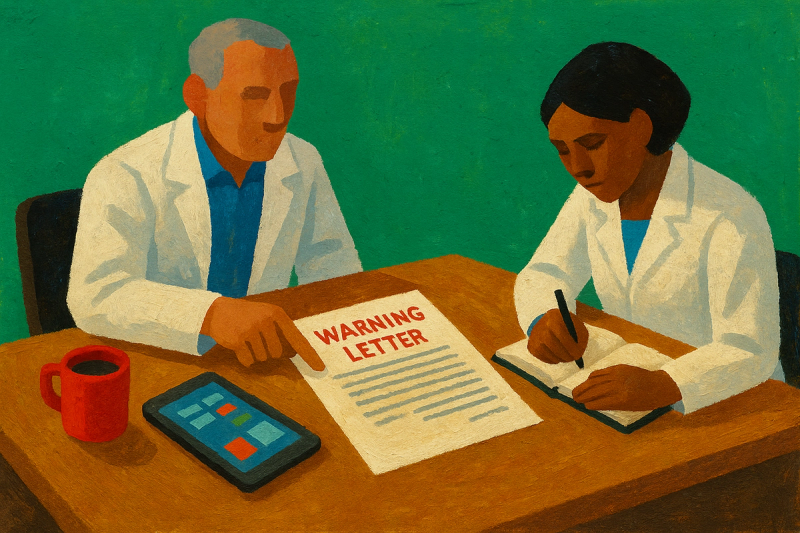
A warning letter is a formal notice from the FDA (or a similar regulator) after an inspection reveals serious problems: manufacturing, data integrity, labeling, quality systems. The letter tells the company to fix the issues and document how. Warning letters are public and can affect exports, approvals, and investor trust.
Why Warning Letters Matter for Investors
- Reputation damage. Customers, partners, and regulators lose confidence.
- Supply risk. Production can be halted, cutting revenue.
- Regulatory escalation. Warning letters can be followed by import alerts, fines, or consent decrees.
- Stock valuation shock. Share prices often drop when warning letters are announced.
- Pipeline risk. New drug approvals can be frozen. Warning letters freeze new approvals (they do not ban sales of existing products, but they do put pipelines on ice).
- Repeated inspections. Multiple problems at one site point to weak quality systems.
Recent Examples
Sun Pharmaceutical
In 2024, Sun Pharma received a warning letter tied to manufacturing practice violations. Investors had to assess supply and export exposure. Sun Pharma's stock dropped roughly 2% on the news.
Zydus Lifesciences
Zydus received a warning letter in 2024 that raised concerns about compliance and global market exposure.
Industry Trend
Across 2024 and 2025, regulators issued a record volume of warning letters to pharma exporters. H2 2025 alone produced 327 warning letters, a 73% increase over the prior period. Recurring themes included weak quality unit oversight, poor manufacturing controls, and unreliable lab testing.
How Regulators Escalate
- Inspection to Form 483. Investigators document observations.
- Company response. Companies have 15 business days to respond to a Form 483.
- Warning letter. Issued if the response is inadequate.
- Further action. Import alerts, recalls, injunctions, consent decrees.
- Close-out letter. Issued when the FDA is satisfied with corrections.
The escalation ladder is not always linear. The FDA can skip steps in severe cases.
Impact on Stock Prices
Warning letters change investor expectations. If issues affect a key product, the stock can drop sharply. Minor issues may cause short-term fluctuations. Systemic failures can reduce value for years. The market weighs two things:
- Severity of violations
- Revenue exposure of affected products
Red Flags for Investors
- Multiple inspections or letters within a short window
- Warning letters affecting core product facilities
- Serious recalls tied to contamination or safety
- Weak or vague company responses
- High U.S. export revenue if U.S. sites are affected
- History of repeated violations
- High remediation spending without visible improvement
- Management turnover in quality and operations roles
Investor Checklist
- Search for the company in warning letter databases.
- Read the warning letter and note specific violations.
- Check company filings for remediation plans.
- Look for recalls or import alerts. Import alerts are facility-specific, not company-wide.
- Estimate how much revenue depends on affected facilities.
- Evaluate management credibility and response speed.
- Assess how long fixes might take.
- Check market reaction and analyst opinions.
- Consider legal or insurance costs.
- Model best, moderate, and worst-case revenue impacts.
 Atlas
AtlasSee what the FDA knows about your next investigator.
700,000+ inspections since 2010. Search by investigator, CFR code, or supplier. Every 483 they’ve issued, in under a second.
How to Read a Warning Letter
When reviewing a letter, pay attention to:
- Scope of violations. Lab, equipment, data integrity, or quality systems.
- Products affected. One drug or multiple.
- Response timeline. Urgent timelines indicate seriousness.
- Nature of misconduct. Deliberate data falsification is worse than process error.
Investor Rules
- Don't panic, but don't ignore. Some letters are minor, others are severe.
- Size investments accordingly. Treat companies with active warning letters as higher risk.
- Prefer diversified firms. Larger companies with multiple plants absorb shocks better than single-site players.
- Check for independent audits. Third-party oversight is a positive signal.
- Time horizon matters. Long-term investors may recover value. Short-term traders may use volatility.
How Long Does Remediation Take?
- Minor issues: weeks to months
- Equipment and process changes: several months
- Systemic failures: more than a year, sometimes multiple years
Portfolio Management
- Diversify across geographies.
- Set stop losses or cap position sizes.
- Keep cash ready for post-overreaction opportunities.
- Balance pharma exposure with safer assets.
Final Buy, Hold, Sell Checklist
- Is the affected site critical for revenue?
- Is there a credible remediation plan?
- Is a recall or import alert already active?
- Does the company have a history of violations?
- Is management transparent?
- Could future approvals be delayed?
Summary
Warning letters are serious. They hurt revenue, reputation, and stock prices. But not all letters are equally damaging. Check severity, revenue exposure, and management response before making any investment decision. Multiple or repeated warning letters are the biggest red flags.
Frequently asked questions
Not always. Check if the plant produces core drugs or if production can shift to another site.

Written by
Atlas Team
The Atlas team brings together expertise in FDA regulatory intelligence, pharmaceutical quality systems, and inspection data analytics.